Gold Is 1 Oz at One Broker, 100 at Another
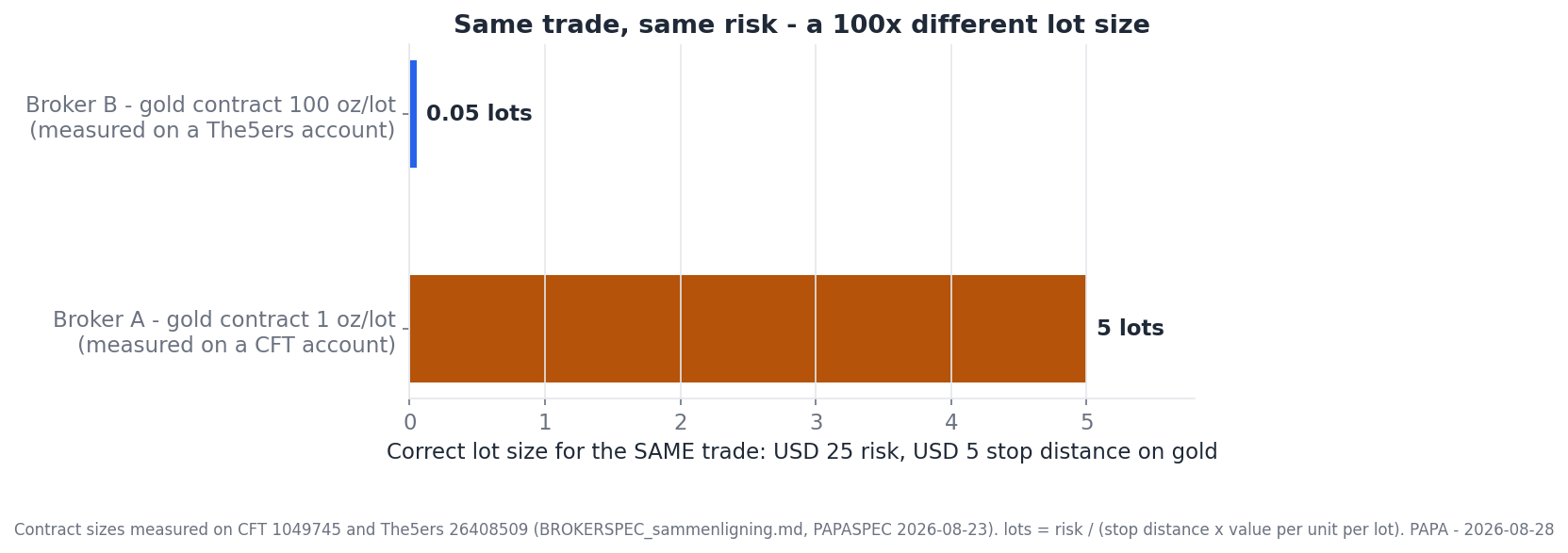
On 9 August I measured the gold contract on two of my funded accounts. Same symbol on the chart — XAUUSD. At one broker (a CFT account), one lot moved my P&L by the value of 1 ounce. At the other (a The5ers account), one lot was 100 ounces. Same formula, same risk, same stop — sizing the CFT trade with the textbook "gold is 100 oz per lot" assumption would have made the position a hundred times too small; the other way round, a hundred times too large. One of those errors wastes a trade. The other ends an account.
The formula is not the problem
Position sizing is one division:
lots = risk ÷ (stop distance × value of one price unit per lot)
The formula is bulletproof. The problem is the right-hand constant. "Value of one price unit per lot" is not a property of gold, or of EURUSD, or of any symbol — it is a property of your broker's contract, and brokers differ. Prop-firm brokers differ more, because many of them run their own feeds and their own contract specs rather than inheriting an exchange standard.
So the rule I trade by now: the constant comes from the terminal, not from a table. In MT5 that means reading SYMBOL_TRADE_TICK_VALUE and SYMBOL_TRADE_TICK_SIZE for the actual symbol on the actual account, and computing the per-lot value from those.
The same broker, three different contracts
The instinct is to let one measurement stand in for a whole asset class: gold is 1 ounce per lot at this broker, so the other metals are "probably similar." On the same CFT account they are not. XAUUSD is 1 ounce per lot. XPTUSD is 100 ounces per lot. XAGUSD is 5,000 ounces per lot. Same broker, same account, three precious metals, three unrelated constants — nothing about gold's contract tells you platinum's or silver's.
(An earlier version of this section told a different story: that MT5's tick value defaults to a stale number before a symbol's first tick, with XAUUSD's 0.0100 reading offered as an example caught in the act. That specific case didn't hold up on review — 0.0100 was already the correct tick value for a 1-ounce contract, not a broken default, and the mistake was expecting 100 ounces because that's the norm at most other brokers. The caution about reading a spec before it has ticked may still be good defensive practice, but I no longer have a real case proving it, so it's out until I do — the same discipline that also caught the five broken index tick values from the broader instrument check.)
What this means in practice
- Never carry contract assumptions between brokers. Two funded accounts, both "gold", can differ by a factor of 100. Metals and indices are the worst offenders; even FX pairs vary in contract size on some prop feeds.
- Read the spec from the account you will trade on. Not the demo, not the other terminal, not last week's cache. On 13 August my own two measurement runs landed on two different accounts — 1047903 and 1046932 — which made both numbers useless for the account that actually mattered. The symbol was identical on both; the account was not.
- Never assume within an asset class either. One broker's three metals can carry three different contract sizes — measure each symbol on its own, even next to one you already checked.
- Do the division before the trade, every trade. Sizing done in the heat of an entry is where the "one big figure off" errors live.
This is also, honestly, why the position-size calculator in PAPA (the prop-firm trading journal I'm building) works the way it does: it computes from the broker's own tick value and tick size, per account, and refuses to pretend a textbook constant is good enough. The formula is free — the discipline of feeding it your broker's numbers is the whole product.
One trader's measurements, described for education. Not investment advice.
PAPA is the prop-firm journal these measurements are being built into — instrument checks, firm rules and compliance buffers, running on your own machine.
Get PAPA — free